
The Frameworks Behind the Long Build System
Three interconnected tools — a motivation-based framework for understanding and optimizing forward movement, a stage model of how significant builds develop over time, and a precision diagnostic instrument —developed to give builders an accurate, specific starting point for advancing their work deliberately movement, a stage model of how significant builds develop over time, and a precision diagnostic instrument — developed to give builders an accurate, specific starting point for advancing their work deliberately.
The DOABLE System™
A Motivation-Based Framework for Forward Movement
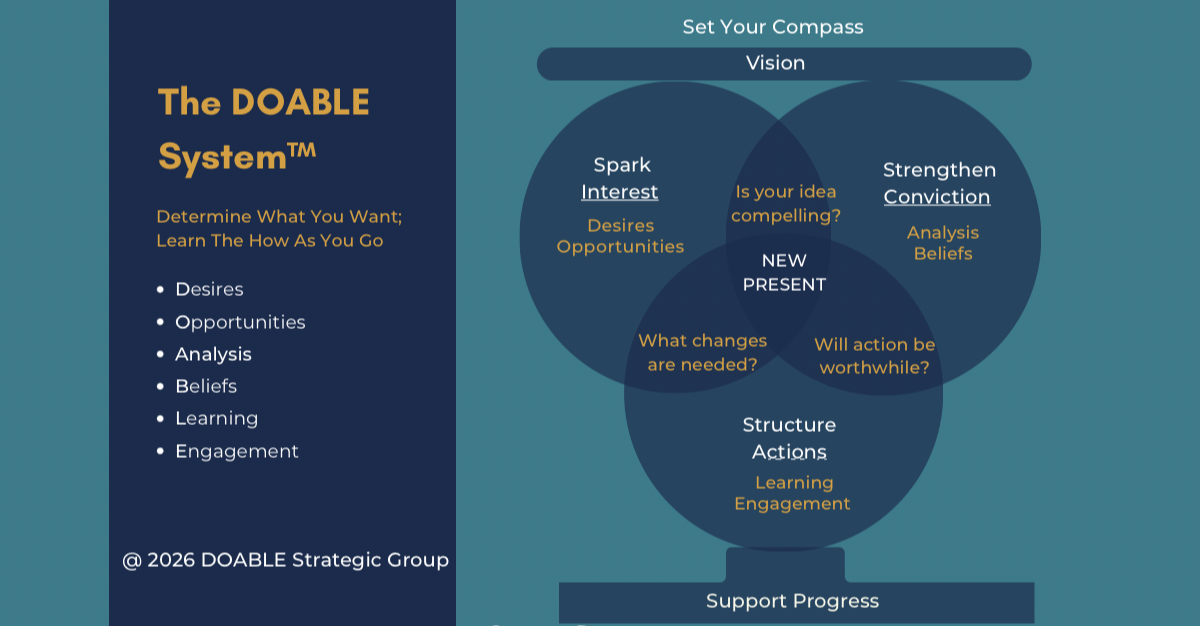
The DOABLE System™ is the intellectual foundation of this work — a motivation-based framework grounded in multiple motivation-relevant theories drawn from the science of how adults initiate, sustain, and advance meaningful work.
Its purpose is both explanatory and practical.
Explanatory: it describes how the six dimensions interact with one another and how those interactions either support or constrain a builder’s ability to move forward. Understanding how the dimensions work together gives builders a way to make sense of what is happening in their build — and why.
Practical: that understanding informs action. When a builder can see which dimension is constraining forward movement and how it is interacting with the others, they can optimize their motivation — making targeted adjustments that actually address the constraint rather than working harder against it.
The framework is iterative rather than linear. Builders can enter at any state, move through the states in the order their situation requires, and return to earlier states as the build advances and new challenges emerge. This reflects how motivation actually works— not as a sequence completed once, but as a dynamic system that responds to changing conditions.
The DOABLE Friction Finder™ is the assessment instrument built from this framework — it identifies where a builder currently is across the six dimensions and produces a specific next step.
The framework and the diagnostic are related but distinct: the framework explains the system, the diagnostic measures it.
Five States of Forward Movement
State 1 — Specify Desires
Forward movement begins with getting specific about what you actually want. Not a general vision — a clear, honest articulation of what you want to build, the work you want to be doing, and what matters to you at this stage.
This is where D (Desires) and O (Opportunities) do their first work together. Specifying your desires makes it possible to recognize the opportunities that are genuinely relevant — and to distinguish them from the options that are merely available.
Without this specificity, opportunity recognition is unfocused. With it, the right opportunities become visible.
State 2 — Spark Interest
A specified desire meeting a relevant opportunity produces interest. This is the state where passive awareness becomes active engagement — where you move from knowing something is possible to being genuinely drawn toward pursuing it. Interest is not yet conviction. It is the signal that the direction is worth investigating further. Recognizing that signal — and distinguishing it from novelty, from obligation, or from what others expect — is the specific work of this state.
State 3 — Strengthen Conviction
Conviction is built through two distinct forms of analysis — and both are required before sustained forward movement is possible.
The first is an honest inventory of Access and Capital (A): what do you currently have, what do you need, and is what you need obtainable? This is not just financial capital — it includes relationships, platforms, organizational standing, time, and resources.
The second is an examination of Beliefs (B): what do you believe about yourself, about others, and about your context? Do those beliefs support taking meaningful action — or do they create the conclusion that taking action isn’t worthwhile, isn’t possible, or isn’t yours to take?
Both analyses are required. A builder who has access but not belief will not act. A builder who has belief but not access cannot act. Conviction requires both.
State 4 — Structure Actions
With conviction in place, the work turns to building the specific structure that advances the build. This is where Learning (L) and Engagement (E) become the primary dimensions. What do you need to learn to execute at the level this build requires? And how do you structure your engagement with the work - your time, your systems, your environment — to make consistent forward movement possible? The Structure Actions state is not about planning in the abstract. It is about designing the specific conditions under which the build actually advances.
State 5 — Support Progress
Forward movement, once initiated, requires mechanisms that sustain it over time. This is the sustaining state — the structures, relationships, accountability systems, and practices that keep the build advancing when conditions are difficult, when motivation fluctuates, and when the demands of the present threaten to crowd out the demands of the build.
Support Progress is not a final step. It operates across all states — and returning to it is often
what makes it possible to re-enter an earlier state and advance from there.
The DOABLE acronym:
D — Desires
What you want your work to produce. The filter every direction, opportunity, and decision runs through.
O — Opportunities
The relevant options the build makes visible — distinguished from options that are merely available.
A — Access / Capital
What you have and what you need. Relationships, resources, platforms, funding, organizational standing.
B — Beliefs
What you believe about yourself, others, and your context — and whether those beliefs support or constrain the forward movement the build requires.
L — Learning
The specific knowledge and capability development the build requires at its current stage.
E — Engagement
How you structure consistent, sustained engagement with the build — independent of motivation alone.
The DOABLE System™ does not prescribe a single path. It illuminates how the six dimensions are interacting in a specific build — and gives the builder the understanding and the tools to optimize that interaction so that forward movement becomes deliberate rather than accidental.
The Long Build™
A Stage Model of Building Impact
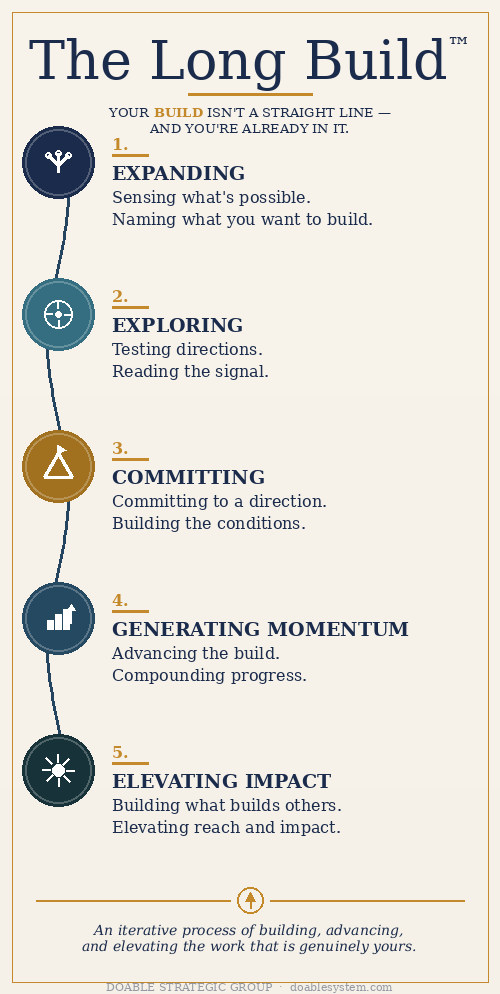
The Long Build™ maps the full arc of how significant builds develop — from the earliest moment of sensing what’s possible through building work that creates impact beyond your direct effort.
It gives The DOABLE System™ its context. The same friction type presents differently and requires a different response depending on which stage of the build you are in. The Long Build™ makes that distinction precise.
Every stage in The Long Build™ is a building stage. There is no stage where the work is waiting. The question at every stage is the same: what does this stage specifically require?
The 5 Stages of the Long Build™:
Stage 1 — EXPANDING
Sensing what’s possible. Naming what you want to build.
The Expanding stage is the earliest movement of a significant build. A direction is becoming visible — not yet clear enough to commit to, but real enough that the old assumptions are beginning to loosen.
The specific work of the Expanding stage is accumulating signal honestly — without forcing it to point anywhere before it is ready, and without requiring clarity before the exploration begins.
-----
Stage 2 — EXPLORING
Testing directions. Reading the signal.
The Exploring stage is the active testing of directions — conversations, experiments, and the building of genuine understanding about what you want to build and whether it is worth committing to.
The specific work of the Exploring stage is reading the signal that exploration has already produced —not generating more signal, but interpreting what is already there honestly enough to move toward commitment.
-----
Stage 3 — COMMITTING
Committed to a direction. Building the conditions.
The Committing stage begins with a decision — a genuine, protected commitment to a specific direction — and the work of building the conditions that will allow that direction to succeed.
The Committing stage is where the build becomes real. It is also where directional doubt is most persistent and most likely to be misread as a signal to redirect rather than as a normal feature of early commitment.
-----
Stage 4 — GENERATING MOMENTUM
Advancing the build. Compounding progress.
The Generating Momentum stage is the stage of active, advancing, compounding progress. The direction is proven. The commitment is sustained. The work is producing visible results.
The specific challenge of this stage is keeping the build’s advancement consistent — moving from episodic progress to compounding momentum — and building the structure that sustains that advancement at scale over time.
-----
Stage 5 — ELEVATING IMPACT
Building what builds others. Elevating reach and impact.
The Elevating Impact stage is where the work creates impact beyond your direct effort —through others, through systems, through platforms, through a body of work that continues to build independently of your sustained personal involvement.
The specific work of this stage is building the infrastructure, the team, and the systems that extend the impact’s reach — and claiming the stage the work has earned at the level it actually warrants.
-----
The Long Build™ is not a linear sequence. Builders can find themselves between stages, cycling back through earlier stages as new challenges emerge, or navigating multiple stages simultaneously in different areas of their work.
What the model provides is not a prescribed path — it is precise language for where a build actually is and what that stage specifically requires. That precision is what makes the DOABLE System™ more targeted and the Diagnostic result more meaningful.
DOABLE Friction Finder™
Your Primary Friction Type — and What to Do About It
The DOABLE Friction Finder™ is an assessment instrument built directly from The DOABLE System™.
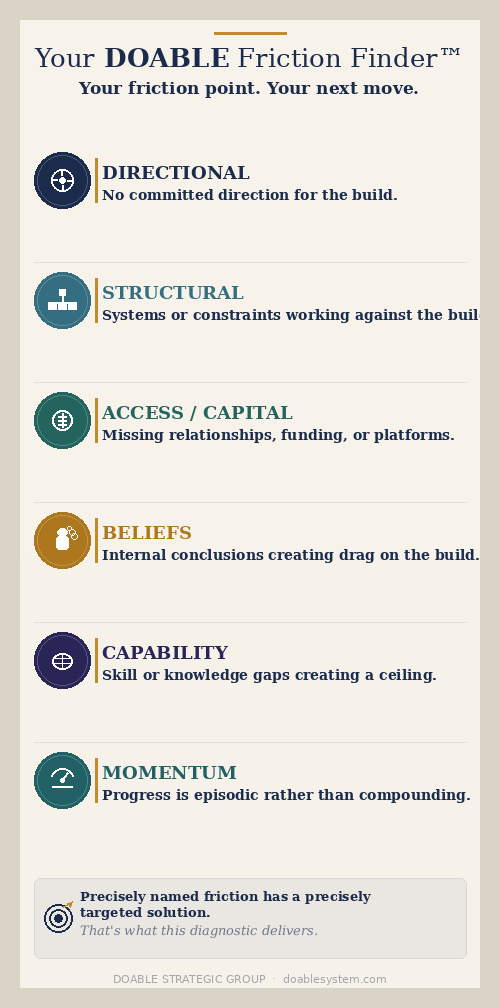
It identifies which of six friction types is creating the most drag on your build right now — and gives you recommended actions for overcoming that specific friction.
It stands on its own as a complete, actionable result. You do not need to take anything else to use it.
What the DOABLE Friction Finder™ produces: You answer a short set of questions about your current build experience. The diagnostic identifies your primary friction type from six possibilities — each rooted in one or more dimensions of The DOABLE System™ — and delivers recommended actions targeted specifically to that friction type.
The Six Friction Types include:
1 - Directional friction - No committed direction yet, or a direction that keeps being second-guessed when the build needs full commitment.
2 - Structural friction - Systems, schedules, role obligations, or environments that were built for a different version of what you’re doing and are now working against the build.
3 - Access / Capital friction - Missing the relationships, platforms, funding, or organizational sponsorship the build requires to advance.
4 - Beliefs friction - Internal conclusions about what you’re allowed to build, what scale is appropriate, or whether this is genuinely yours — creating drag on a build the evidence already supports.
5 - Capability friction - A specific gap between what you know and what the next level of the build requires — not a general development need, a precise and addressable constraint.
6 - Momentum friction - Progress that is real but episodic — advancing when conditions are right and losing ground when they aren’t, rather than compounding consistently over time.
-----
What you leave with: Your primary friction type — named specifically.
Recommended actions for overcoming that friction in your current build.
A clear, targeted starting point you can use immediately.
When Combined with the Long Build Profile™:
Taking the DOABLE Friction Finder alone gives you your primary friction type and the actions recommended for it. That result is complete and actionable on its own.
Taking both instruments together produces something more precise.
The Long Build Profile™ identifies your current stage in the arc of the build — Expanding, Exploring, Committing, Generating Momentum, or Elevating Impact. When that stage result is combined with your primary friction type, the recommended actions become significantly more targeted: not just what to do about Structural friction, but what to do about Structural friction specifically at the Committing stage, which looks different from Structural friction at the Generating Momentum stage.
There are 30 possible combinations of stage and friction type. Each combination has its own distinct profile — its own meaning, its own stage-specific priorities, and its own highest-leverage first move.
Taking both instruments and using the same email address is how you get yours.
